Showing posts with label Atmosphere. Show all posts

Sunday, 15 October 2017

Spontaneous Sunday: Gone Home

That's right, Spontaneous Sunday is back! Though I submitted my final MA work last week, I've decided to keep on doing Spontaneous Sunday posts every so often. I've found them to be really beneficial to my knowledge of game design and they encourage me to play games that I might not otherwise play (also its pretty fun!).

This week I have played Gone Home: Console Edition (2016, Midnight City, Xbox One. Original version released 2013, The Fullbright Company, PC). Gone Home is a game that has intrigued me for a while because of its focus on environmental storytelling and atmosphere. Earlier this year I had a short email conversation with one of the game's environment artists (Kate Craig) for one of my MA research modules which piqued my interest further. When I found that the game is free on Xbox Live this month, I just had to play it!

"Gone Home is a first-person adventure exploration video game developed and published by The Fullbright Company. Set in the year 1995, the plot focuses on exploration of a house in Portland, Oregon, and examining common household objects within the home to unlock journal entries and discover the recent events that took place there."
- Wikipedia on Gone Home


What do I expect from the game?

As I have looked into the game quite a bit before playing it, I think I have a pretty good idea of what to expect. I expect Gone Home to a be a minimalistic, slow-paced exploration game set in a single house environment, with the emphasis of the gameplay being on interacting with things in the environment in order to slowly uncover a story. I expect that the game will lack a linear story or any interaction with other characters, instead allowing the player to discover things in their own order and at their own pace.

I expect that the game's strengths will include its environments, immersion, atmosphere, storytelling, attention-to-detail and the unique nature of its concept. The idea of a story-driven exploration game set in a single house strikes me as creative and intriguing but risky - it will be interesting to see how the game functions without many game-like elements or a direct goal or challenge. I've heard good things about the game so I'm pretty excited to get into it. I expect that my enjoyment of the game will rely on the quality of the storytelling and how immersive the environments are, so I plan to play it in the dark with headphones on to get the full atmospheric effect!

First Impressions - What do I think of the game in its first few minutes?

The game begins in a rather reserved way, with the developer idents silently fading in and out. The title screen and music slowly then slowly fade in. The front-end music is similarly reserved, with multiple layers of soft string chords creating a soundtrack that is an interesting mix of solemn and contemplative but warm and homely - I expect that the mood conveyed by the opening music will be present throughout the game itself aswell. The front-end is pretty minimalistic, with the static background image of a large wooden house at night, with a single light on upstairs and trees in the foreground. Its an interesting visual style, somewhat reminiscent of old cartoons and graphic novels. I  briefly considered the symbolism of certain elements of the artwork - I get the impression that this game was a very personal project for the 4-person development team and as a result, deep meaning is likely to be present in most elements including the main menu artwork.


The main menu UI is simple, with just two options on its main screen: "new game" and "options". I think that the fact that the environment seen on the main menu is simply a static image and not a real-time environment was something of a missed opportunity. It could have had clouds moving in the night sky above the house, the light flickering, trees swaying in the wind and so on. There is also a noticeable lack of any ambient SFX on the title screen, which is a shame because the sound of wind blowing and crickets chirping could have elevated the atmosphere more. With all that said, its possible that this stripped-back effect was intentional and the developers didn't want the main menu to distract the player by having too much visuals and audio to take in.

I began a new game and was greeted by a controls screen that showed how to move around (left stick) and how to look around (right stick) and that was it! I also checked out a page of "modifiers" which apparently result in a "non-standard experience". These included things such as turning on developer commentary and having all the doors in the house unlocked from the start. The player is able to activate any of these modifiers on their very first playthrough, which struck me as odd: I am given to understand that the game can be completed in quite a short amount of time, so I would have expected these options to become available after the game is completed in order to both reward the player and encourage repeat playthroughs thus lengthening the game's lifespan.

The modifiers page.
The player's first view of the game world.

The game begins with the player-character, Katie, arriving home after a year in Europe. Her family have moved into a big old house since she left, and she arrives to find it unfamiliar and empty. Starting in the house's porch, the player first has to find the hidden key to unlock the front door and access the house proper. On the front door is a note to Katie from her younger sister Sam, saying that she is not there but they will "see each other again some day" - note sets the scene of mystery early on and prompts the player to immediately begin questioning what is happening or has happened in the house. Thereafter, the game's story steadily begins to add up. There is a large amount of objects to interact with and inspect and notes to read, which each either shed some light or add some mystery to the main story, tell the player something about one of the family members, or simply add to the game's backstory. The player is therefore able to glean small bits of information regularly that allows them to slowly build an understanding of such things as the family member's history, current struggles and events from the past.

Sam's note to Katie.

I set about exploring the house, examining objects and turning up notes that offered information of varied usefulness. It didn't take me long at all to become immersed in the game and begin to care about the character's and figuring out the story behind the mysterious absence of any family members from the house. I was instantly impressed by the game's ambient audio, and the graphics are also decent - though they would be even better if the game used PBR textures. The effect of rain running down the house's windows was a particularly nice visual effect.


I think that the game starts out pretty strongly. The simplicity of the main menu and the music sets the player up for the slow-paced, reserved experience of the game itself, and the opening gameplay of arriving at the house feels well-executed and appropriate. Sam's note on the door is the first sign that something may be amiss in the house, and it gives just the right amount of mystery to the opening section that will spur the player on through the game to figure out what the story is.

What do I like about the game?

I played Gone Home for about 3 hours, and in that time I explored much of the house and gathered a decent amount of information - enough to have a pretty good understanding of each of the family members. Though I hadn't really gleaned anything that could hint at the whereabouts of the family, I had discovered a lot of other information that I could tell would prove important later on. The game's main stand-out features are its concept, its story, its atmosphere and the quality and detail of the environments.

Gone Home is definitely an interesting concept for a game and it was very enjoyable despite (or perhaps thanks to) its lack of classic game-like elements. It's an interesting experience quite unlike any other game that I can remember playing. Most of its features are distinctly un-gamelike, from the slow movement speed of the character, to the lack of urgency or failure. In terms of how the player moves and interacts with their surroundings, the game seems to be intended to mimic real life more than other games. This means that the game provides an immersive experience that puts the story in the spotlight and makes it the main feature. The player is mostly free to approach the game however they want, which gives a sense of control over the proceedings and a sense of accomplishment when your exploration yields meaningful results such as uncovering important information or something hidden away.


Another interesting point about the game's concept is that it could only ever have worked as an indie game. Gone Home seems to be infused with personality and nostalgia from the small development team's own experiences memories. The developers presumably grew up in the 90's (the game is set in 1995), which would make this a personal project for them and allow them to add to the richness of the story and setting. I also think that indie games are allowed more creative freedom by both publishers and players. If this game was made by a major high-profile studio, it wouldn't have had the personality that it does and would probably have been watered down and edited by a publisher so it could have mass appeal. It is a risky concept, and this makes Gone Home stand out to me as a good example of the value of the creative freedom of independent game development.
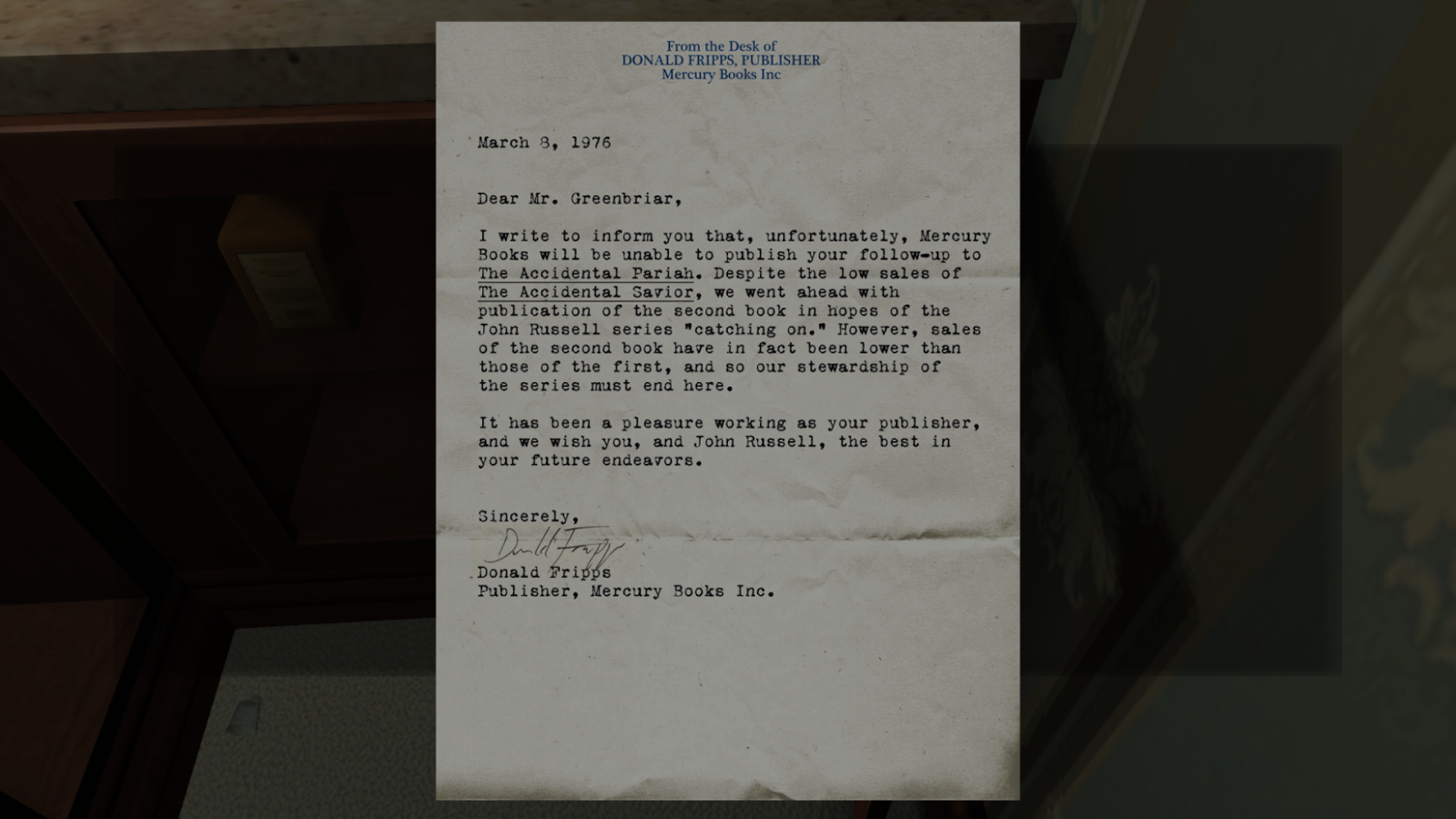

Gone Home's story is another very strong feature, and it is what the whole game balances on. The game's whole focus is on navigating a space and interacting with your surroundings in order to gather information. I went into the game without any significant knowledge of the story, and its been an interesting and rather unique experience.


The story is unlocked linearly and actually focuses more on Sam than on Katie (who is the playable character but is relatively rarely mentioned, and usually its something mundane like homework notes) with a couple of subplots that focus on the parents. I won't go into too much detail for risk of dropping spoilers, but the story is very interesting and often relatable, and it also happens to be expertly delivered. Most information is found by examining notes, documents and important items, some of which will play a voiceover from Sam herself, who steadily reveals her story. The voiceovers are stored in a journal menu and can be played back. All the while, other items around the house offer lesser details that add greater depth and context to the stories and characters. I didn't finish the game, but I think I made a lot of progress and it has definitely gripped me.

Sam's bedroom.

Voiceovers in the journal.
The game's atmosphere is another prominent feature. The house feels at the same time homely yet unfamiliar, calming yet tense. The atmosphere is brilliant established through the use of lighting, ambient audio and environmental storytelling. The house is naturally very dark, but the player can turn lights on throughout the house. This means that new areas are shrouded in darkness which adds a level of realism to the exploration. The lights themselves contribute to the atmosphere by subtly illuminating certain areas, and casting long shadows in others. I think the environments could benefit from more contrast, with shadows being darker and illuminated areas lighter (perhaps I'll tweak the video settings in the options menu). Ambient audio is another huge factor in the game's atmosphere. The events of the game take place on a stormy night, so the constant sound of rain outside makes up much of the ambience, but there are also sounds of thunder, subtle distant banging and very occasionally, a very quiet and fleeting sound of whispering - which I suspect is meant to unnerve the player and make them question whether they imagined it. When I first heard it, it was pretty effective!
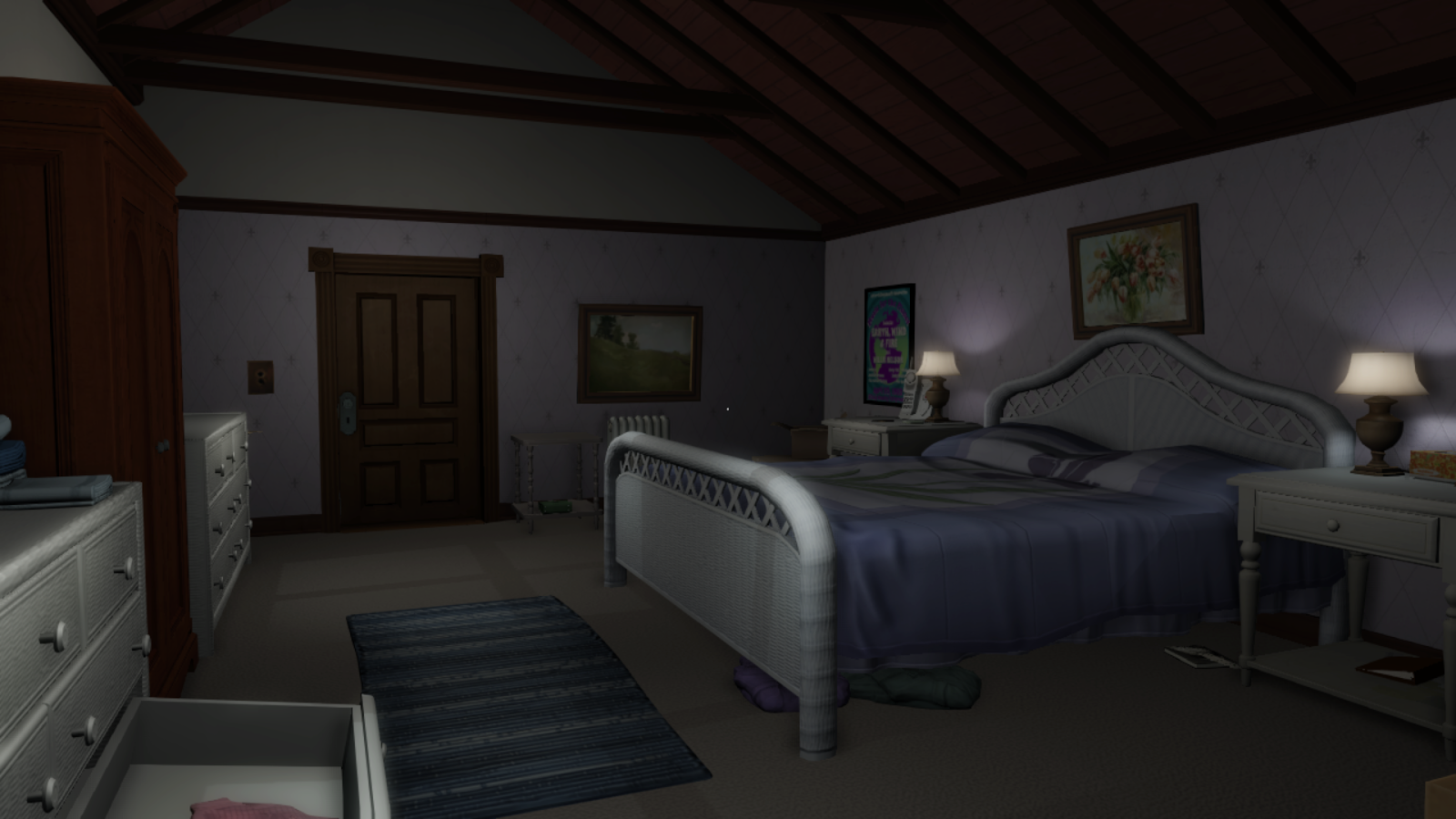
The house's master bedroom.

The environmental storytelling also helps to create a strong atmosphere. The environments are all very detailed and each room feels unique and has something to offer. The notes and documents are the most obvious example of environmental storytelling, but the house also contains lots of objects that can be examined such as regular household items, personal effects, newspapers, books and posters. Everything has a distinctly familiar 90's theme, including labelled VHS tapes and cassette tapes, game cartridges and 90's products and decor. Many of the notes and objects are related somehow which means small story arcs often crop up. It all adds to the detail and believability of the setting, which is a vital part in the creation of atmosphere.

The player also gets a map to help them navigate.
Finally, there is the quality of the environment art and 3D assets. The whole house environment is very well crafted and detailed with high quality 3D models and textures throughout. The art is actually lower-poly than I had expected but the overall graphics don't really suffer a result. The environment is believable which also helps the game's atmosphere. Because the playable area is relatively small, the artists will have been able to spend a lot of time and effort on making each room  as good as possible, and this shows through the quality of the environments. Each room looks lived in and has its own clear aesthetic, purpose and identity, just as a real house would. Its easy to buy into the games story when exploring such well-crafted and atmospheric environments.

The house's main hall.

What do I not like?

Gone Home is another one of those games that I just find it really difficult to find any criticism for. Aside from the few minor points that I made earlier (the menu screen being too static and the lack of PBR textures), I've drawn a blank for negative points. As the story is so crucial to the game, the only thing I can see tainting my opinion is if the ending of the story is a disappointment - I guess time will tell on that front!

Final Thoughts

Gone Home is probably one of the most outstanding games I have played for Spontaneous Sunday. It offers a really unique gaming experience that is atmospheric, engaging and thought-provoking. The story, which is compelling and well-delivered, combines with the game's strong atmosphere and art to make for an enjoyable and enthralling game. The ambient SFX and the 1995 setting are also good features. Gone Home has gripped me (as I had expected it to), and I will be playing it again very soon!


Saturday, 30 September 2017

Sci-fi Garage Update - September 30th

Time for another sci-fi garage update. This week, I've been pushing through the final props for the scene and making finishing touches and tweaks to the textures, visuals and particle effects. I've also made a start on the camera cuts in UE4's sequencer feature so its ready to render the video when the scene is finally finished. With about a week and a half left until the deadline of October 10th, I'm now tying up loose ends and making final additions. The scene is now pretty much finished - I've made every prop that I planned to include and all thats left to do is get the final post-processing settings in place.
 
On Wednesday, I'm going into the games studio to render the level flythrough, which I will then edit together into a final presentation video that will be included in my final submission. I will also be creating audio (both SFX and ambient music) for the video over the next week or so. Finally, I will be taking a bunch of screenshots including shots of the scene, beauty shots of individual assets, and additional pictures for the write-up. I'll be making a detailed write-up about my creative process, project pipeline, design decisions etc and posting that on here along with my submission. So my final submission will consist of a flythrough video, screenshots and a reflective write-up.

Anyway, here is a list of what I've done since my last update:

  • Created many new assets including...:
  • Posters for the garage walls, which come in 3 designs.
  • Various signs for the walls, including no smoking signs, fire extinguisher signs and warning signs.
  • A classic red mechanic's tool chest.
  • A military ammo box.
  • Various tools/clutter including a paint brush, screw driver, duct tape and some bottles.
  • A construction light.
  • A fire extinguisher.
  • A computer console that sits on the mezzanine floor/gantry.
  • I've also made a couple of grunge textures for the walls and floor, including grunge-y rust and drips.
  • I've made some changes to several of the textures, tweaking metallic and roughness values on various props.
  • I've also reworked the pipe texture.
  • I've made screen displays for the APC's dashboard and the laptop screens.
I'm really happy with how everything has turned out and I'm excited to get the project finished up to as high a standard as I can. Bring on next week!

Here's some pictures of the scene now:


Tuesday, 19 September 2017

Sci-fi Garage Update - September 19th

The October 10th deadline for Design Practice 3 is slowly creeping up, and I've been putting in many, many hours of work. Over the last couple of weeks since my last post, I've made a load of new props and made some very drastic changes to the lighting and colours. I'm pretty sure that the difference between the screenshots in this post and my last post will be the most drastic difference of any two consecutive posts so far. I've spent countless hours in Maya, Substance Painter and UE4 (including a couple of all-nighters) and I've now got my asset creation workflow down to a fine art and modelling and texturing has almost become second nature!

I went into the games studio this week to seek feedback on my work and I've now begun to action the feedback. While there, I converted my scene into UE4 version 4.17 (it was previously 4.15), which features volumetric fog. I've now applied volumetric fog to the scene and I'm really happy with the results. This is how I've achieved the bloom effect on the APC's headlights. I also used to make a hazy lighting effect around the windows. I've turned the APC so its at a very slight angle. I've added some mid-intensity blue-tinted lights alongside the APC to add more highlights to it, and used post-processing to darken the shadows to create more contrast. I've tweaked the APC model itself slightly too: I've adjusted the angle and geometry of the flag so that it looks more like its hanging the flying, and I've altered the angle of the gun so its aiming upwards at a more severe angle.

Here's a list of all the assets that I've done since my last update:

  • A metal barrier with emmisive lighting.
  • A notice board with papers including blueprints of the APC, post-it notes and various technical information about bullets that I copy-pasted from the internet. One page displays the date "June 17th 2047" which is a subtle way of putting a timeframe to the scene.
  • A metal table.
  • A military laptop (a.k.a "toughbook"). This was the most demanding asset that I have made since the APC itself, and it is over 5k tris as its meant to be a bit of a "hero prop". It is a fictional design that draws from a number of modern examples. The laptop features emmisive textures to create the effect of the screen being lit and an underlit keyboard. It took about 3 days to model and texture, but I might tweak the texture some more yet.
  • A fire exit sign, again with emmisive textures. This adds to the scene's realism and industrial feel, while also allowing me to inject a little more colour into the scene.
  • A big map, featuring hand-drawn tactical information. This is another focal prop and its meant to give the impression of important military manouvres happening and being commanded from the hangar.
  • Metal folding chairs with padded pleather seats and backs.
  • A first aid box.
  • 3 different coloured spray paint cans (green, red and blue). The paint cans share the same texture sheet for better optimisation.
  • A wooden shipping crate. The crate bears markings of "DANGER" and a military-esque star logo. Having more wood texture in the scene adds variety to the materials and should help break up the metal and concrete.
 I feel like I'm making good progress on the project and I'm very close to the "finishing touches" stage. I've begun to think about the presentation video and will likely get to work on it within the next couple of weeks.

Here's some pictures of the scene:


Tuesday, 11 April 2017

An Analysis of the Atmosphere of Battlefield 1

As the focus of my MA Games Design studies is the creation of atmosphere in games, I have decided that its time I really began to analyse games that I find particularly atmospheric. Through in-depth critical analysis of all of the relevant features and elements of a game and its environments, I will try to break down everything that contributes to the atmosphere of the game in question and apply my findings to my own game design and environment art.

I will try to do an analysis fairly often, though as of yet I don't plan to do them to a set schedule. These posts will differ from my regular Spontaneous Sunday posts in that they will focus specifically on atmosphere, and I'll be playing games that I have played before. I may even look at other media such as films, or real life places/events - all time permitting of course.


---------------------------------------------------


In this piece of writing, I will be analysing the atmosphere of EA DICE's WW1 first-person shooter, Battlefield 1, using my own experiences playing the game and any relevant articles and resources that I can find. I have spent many hours playing the single player campaign and multiplayer and have also conducted extensive research and gathered information in order to gain an informed opinion.

As a high-profile, current-gen AAA title, Battlefield 1 arguably achieves some of the highest levels of realism currently possible in a video game. When discussing atmospheric realism, realistic graphics is a topic that is pretty much always mentioned, and Battlefield 1's graphics are definitely of a very high standard. The game uses the latest version of the Frostbite engine which allows for hyper-realistic PBR texturing, advanced development tools, accurate physics, realistic lighting, dynamic weather systems and enhanced facial animations. In fact, EA DICE have such confidence in their engine that it has been reported that they will be working towards starting to use it for all of their releases in the future [1].

The graphical quality of the game really comes into it's own during the cinematics and cut-scenes in the first-person campaign. Its here that the engine's graphics and facial animation capabilities shine, making for an authentic and cinematic quality to the game's cutscenes. The characters are believable thanks to the quality of the facial graphics and the voice acting and scripting. All of this means that the cinematics help to set the scene and establish the characters and allow the player to suspend their disbelief, which makes the feelings of atmosphere and immersion more readily experienced and accepted.

Taking a slight segue from the topic of realism, the question arises of how historically accurate Battlefield 1 actually is (though I will not be getting too into this as it is another matter). Senior Producer at DICE, Aleksander Grøndal, in an interview with Motherboard, said "It's just an interesting era. We're not trying to create a documentary about that era. We're trying to make a game, it's supposed to be fun first so, of course, we're going to take some creative liberties where we can." [4]

Screenshot from a campaign cinematic.
The quality of the games art and visuals is thanks to the skill of the artists and the quality of the tools that they use. EA DICE uses such top-of-the-range software as Maya, Photoshop, zBrush, Mudbox and Substance Suite, and processes such as photogrammetry to create art assets. Photogrammetry is a process that "involves taking a ton of photos of real, actual things/places. Those photos are then scanned, meshed together and turned into 3D landscapes." [2] Performance and rendering settings and techniques also play their part in the graphical quality of the game. As one would expect, the best graphical quality can be achieved on max settings on PC, offering such things as higher resolution shadows and greater draw distances.  Meanwhile, Xbox One and PS4 graphics are apparently comparable to medium PC settings. With such high quality graphics, a game runs the risk of suffering from immersion-breaking performance issues and frame-rate drops, which can compromise the atmosphere. EA DICE's efforts to tackle this issue include using LOD models and textures, shorter draw distances and culling of particle effects, all on a "scene-by-scene basis" [3], this means that the game runs smoothly and immersion is not broken.


The games unique settings also help to enable its strong atmosphere. Battlefield 1 is the only mainstream FPS set in World War 1 that I am aware of. As such, it is a unique and interesting setting that offers a lot of opportunities for new scenarios, locales and visuals that most players will have never seen in a game before. I think that EA DICE really used the setting well, including campaigns and multiplayer maps from a wide variety of fronts of WWI including France, Italy, Gallipoli and the Middle East. In my opinion, A key factor in creating atmosphere is to offer unique and new environments and experiences that the player can't help but be drawn into, and I think that Battlefield 1 pulls this off well. An example of a particularly unique and memorable bit of gameplay is when the player takes control of a messenger pigeon in the single player chapter "Through Mud and Blood". This was a very unexpected bit of gameplay, and its a testament to both the creativity of the game's developers and the detail that they went into when trying to portray features of The Great War. It's unique gameplay experiences like this that can make games have a lasting impression on players.


One could argue that games have a greater power to evoke atmosphere in their single player campaigns - where the developers have control over the action and events follow a set path - than multiplayer modes, where action is much more loose and reliant on the players themselves. I believe that this is true for Battlefield 1. In the single player campaign, the player takes on the role of a character that has been created by the developers, and completes activities and tasks set out for them, in environments created specifically for this purpose. This allows the player to place themselves in the characters shoes, with the character and the events that occur acting as a catalyst for the game's atmosphere. However, in multiplayer mode, the player-characters are almost anonymous and the gameplay experience is more freeform as it is essentially created by player action.

While I think that the single player campaign is more atmospheric because it allows you to take on the role of a character in a controlled environment, other gamers may experience a greater sense of atmosphere from the multiplayer because the lack of a clearly set-out character and narrative allows them to create their own personal narrative. This is an example of how atmosphere can be subjective - it depends entirely on the player's own psychology and how they experience atmosphere.

Battlefield 1 offers plenty of opportunity for the player to interact with and alter the environment around them. This sense of agency within your surroundings is a huge source of atmosphere that might not seem terribly important at first, but can do a lot to help ground the player within the game.  The player can open doors and windows, vault over obstacles and use stationary weapons. As well as interactive elements, the levels are also filled with destructible things. Most buildings can be completely levelled with tank fire, artillery or other types of heavy explosives, craters can be created in the ground, and small props like crates and barrels can be blown to bits and scattered around.

Environmental destruction has long been a prominent feature of the Battlefield series, and this feature returns in Battlefield 1 with full force. Almost all the assets in a given environment will be able to receive some level of damage, with most objects and buildings being able to be completely levelled. The environments react accurately to the forces that are exerted upon them. For example, running over a rickety fence in a tank will see the fence splinter and flatten with ease, and shooting a brick building with a rocket gun will blow a sizeable hole at the point of impact, bringing debris raining down. The environment reacts as expected, making for congruence between player action and the in-game result. Dan Berlin, lead world designer at DICE, said "if you expect an explosion to cause a crater, it’s going to cause a crater. What you see is what you get – it’s what we’ve been pushing for the whole time" [5]. The accuracy of the destruction helps to further cement the game's believability and allow the atmosphere to exist. Seeing environmental destruction occur adds to the overall sense of chaos and excitement and adds another layer of agency and responsiveness to the game.

Destroyed buildings in a round of War Pigeons on Suez. These buildings
were perfectly intact at the start of the round.
The sheer depth of environmental destruction that is possible in Battlefield 1 means that the battlefield changes drastically and very realistically over the course of a game. There is also ways in which the player can also use the destructible environments tactically, such as destroying a building that they suspect to contain enemies or destroying objects blocking their paths, and players can take cover in bomb craters that weren't there at the start of the game. In this sense, Battlefield 1's destructible environments affect the gameplay, perhaps more directly and drastically than any other game I have personally played. One instance in which environmental destruction directly affected my own gameplay experience occurred in a multiplayer round in which an enemy sniper was holed up in the attic of a house. A member of my team used an explosive to blow the roof off the building, exposing the enemy sniper and allowing me to use a mortar to take him out.

The ability to interact with your surroundings can take a game's atmosphere to new heights. To see a level change and progress around you in response to your input can really help the player to feel immersed and buy into the illusion of the game. It is very important for game environments to be as interactive as possible to establish a sense agency that aids immersion and atmosphere, and I will make sure to consider this when creating my own environments by providing interactive elements and meaningful consequences to the players input.


For Battlefield 1's multiplayer mode, EA DICE set out to create a game in which each round is different and unique - "Even after multiple matches, you will encounter a combination of weather, location and gameplay you've never experienced before, with a new dimension to your Battlefield moments." [6]. This sense of unpredictability surely adds to the immersion - if the player is always unsure of what to expect, they are less likely to become disinterested and therefore have their immersion broken

One major catalyst of variety and immersion is the game's dynamic weather system. The weather within a level can change over the course of the game, and possible weather systems include clear, overcast, rain, fog and even sandstorms, all of which look and feel very convincing. Different weather can force players to alter their play style, which in itself can change the pace of a game. Gamespot's Mike Mahardy wrote "I played one match, but it felt like three: the San Quentin Scar, as DICE calls it, began with ample space for me to cover through the scope of my rifle. But the fog transformed it into a massive close-quarters battle" [7]. Rain, on the other hand, distorts your vision at long distances and even affects textures, such as turning the terrain into mud.

Fog rolls in over a round of domination on Giant's Shadow, greatly
reducing visibility and sight-lines.
An example of many particle systems on screen at once.
Visual special effects play a huge role in creating this convincing portrayal of the dramatic, violent and high-energy era of history that is World War 1. VFX has been described as "everything that moves that isn't a character" [8] which is, of course, an awful lot of stuff. VFX in Battlefield 1 takes many forms, from particle effects of explosions, fire, smoke, weather and clouds of gas, to post-processing and lighting. In my opinion, visual effects in games is a sort of "top layer" that adds to and augments the visual experience. It is still incredibly important, of course - especially in a first person shooter, where the atmosphere hinges largely on how well the chaos and destruction is captured. Particle effects are a huge factor in the visuals of Battlefield 1. There is scarcely a moment where there is not multiple particle effects on screen. The particle effects are realistic and dynamic, and they affect visibility and lighting in a convincing, almost tangible way. The particle effects are so well-optimised that there can be any number of particle effects visible at one time, even at long distances, which is a testament to the optimisation skill of the game's VFX artists. The quality, variety and number of particle effects contributes greatly to the visual experience and the overall atmosphere of the game.


Lighting is often cited as one of the most crucial contributing factors of atmosphere in games. Like just about every other visual factor present in Battlefield 1, lighting is used to great atmosphere effect.  Lighting effects present in Battlefield 1 include dynamic lighting, ambient occlusion, bloom and flares. The power of the Frostbite engine allows the game's artists to achieve high quality and realistic lighting. The game features rays of light streaming through trees and lighting effects such as exterior areas appearing brighter if being viewed from an interior, e.g through a window. This mimics the way human eyes receive and process light. The lighting is also consistent with the current weather conditions and as such can change drastically throughout a level and have a great impact on the mood of an environment. The single player campaign features some stealthy and night-time missions, the atmosphere of which depends heavily on the quality of the lighting. Light is used to pinpoint areas of interest or enemy activity, which informs and guides the player. Overall, lighting is used well to contribute to the atmosphere.

Light streaming through trees in Fog of War campaign level.
Subtly illuminated enemy encampment in the campaign level Young Men's Work
Audio is undoubtedly a crucial part of the atmosphere of any game. Lead Sound Designer Mari Saastamoinen Minto had the following to say about the audio of Battlefield 1: "The level audio in Battlefield is an everlasting challenge that constantly changes, and as sound designers we need to really nail those soundscapes so the players feel immersed and also believe in the worlds we are building" [9]. Audio has tremendous power to establish atmosphere, and is often cited as a factor that can make or break a game. Recreating the sounds of World War I can't have been an easy feat, but the game's audio team have done a very good job of it.

Battlefield 1 has some of the highest quality audio of any current game. The sound effects are authentic with gun shots and explosions sounding weighty and purposeful. Every sound, from the largest explosions causing buildings to collapse to the sound of falling shell casings from machine guns, has been created with great care by the game's audio team. One particularly impressive feature of the sound design is how sounds change depending on the player-character's distance from them and the direction of the sound's source. The accuracy of the audio means that you will often find yourself ducking for cover with real urgency at the sound of bullets whizzing by you and ricocheting into the scenery. No other game that I have played has simulated the sound of being under fire so accurately. Good FPS sound design should be able to communicate situations to the player and markedly affect how they interact with and experience their environment, and Battlefield 1 definitely ticks this box. The consistency between the action, the visuals and the audio is near-perfect.


Music is another huge factor in creating atmosphere. In Battlefield 1, music is used to create a mood and tone and it influences (and is influenced by) the nature and pace of the action that occurs. The game's varied score helps to establish a variety of emotions from the noble, heroic bravado of World War I, to the conflicts more sombre, fearful and hopeless side. The game's soundtrack is invariably emotive and grand. It is also dynamic, with the music becoming more driving and energetic during especially dramatic single-player sequences and as multiplayer rounds near their end, which in turn spurs players on to make their final desperate grasps at victory almost subconsciously. Finally, there is the voice acting, which is again well executed and convincing. This gives the different characters and armies a lot of personality, authenticity and identity. On top of all this, the game offers several different audio presets, including the "War Tapes" setting that compresses and distorts the audio to make it sound like vintage film-reel footage of wars. This subtle change affects the gameplay experience more than one might expect. My personal favourite audio setup is wearing headphones and using the "headphones" sound preset, as this allows for the greatest clarity and sense of directional audio.

The list of things that contribute to the creation of atmosphere in Battlefield 1 goes on and on, and there's plenty more "miscellaneous" features such as the fact that great plumes of smoke can be seen on the horizon far outside of the boundaries of maps which gives a sense of greater scale to the battles, and that the audio lines of soldiers from different countries are all spoken in their native language. If I had to think of ways that the atmosphere could be improved, I would say that the addition of more natural sounds (such as more birdsong in forest levels) could add to the atmosphere. I also think that the game could benefit from having more consequences to taking damage than simply losing health, such as being knocked to the ground and temporarily deafened by explosions. This could help to humanise the player-character more and add corporeality.

Overall, I think that Battlefield 1 stands as an example of the atmospheric power of games. Being a AAA title, the game had a big budget and was created by top-tier artists from around the world using the most up-to-date and powerful software. In a way, it shows what a game can be when all the stops are pulled out. Factors such as realistic graphics, unique settings, environmental interactivity, dynamic weather, visual effects, lighting and audio all come together to create a very atmospheric experience. In terms of my own practice, I believe that taking design principles from Battlefield 1 and applying them to my own environment art could help to elevate the atmosphere of my own environments. In writing this piece, I have gained valuable experience in critically analysing game atmosphere. I've also learned a lot about areas of game development that I had not properly looked into before, such as visual special effects, which has helped me to broaden my general game knowledge.


---------------------------------------------------


I have collated all of the resources that I used in the reference list and link list below:

References

[1] Porter, J. June 2016. "From Battlefield to FIFA: Here's What The Frostbite Revolution Means For You".  TechRadar.

[2] Plunkett, L. March 2016. "We're Getting Dangerously Close to Photo-Realistic Video Game Landscapes".

[3] Bierton, D. October 2016. "Face-Off: Battlefield 1".

[4] Grøndal, A. September 2016. "'Battlefield 1' Sacrificed Historical Accuracy to Make The Great War Fun".


[6] Antroia, R. July 2016. "How Dynamic Weather Changes Battlefield 1"

[7] Mahardy, M. June 2016. "Battlefield 1: How Weather and Destruction Change the Game"

[8] Hubbell, L. 2015. "How To Become A Video Game Special Effects Artist"

[9] Minto, M.S. November 2016. "Behind the incredible sound of ‘Battlefield 1’"


Link List

EA Teases More Games Moving to Frostbite, “Exponential Leaps Forward;” Discusses Move to One Engine - Dualshockers

The 3d artists behind Battlefield 1

Collection of Battefield 1 artists' Artstation portfolios - Artstation

Battlefield 1 Full Official Presentation 6 May 2016 - Youtube Video

Andreas Glad Battlefield 1 VFX Reel - Vimeo video

The Technology Behind Battlefield 1 - g2crowd.com

Battlefield 1 is everything old you loved about the series with new ideas - Techradar

Battlefield 1 review: Military first-person shooter sets new standards - Pocket-lint

Why I Make Games: Daniel Berlin - EA.com

Battlefield 1: Designing Beasts of War - 80level

What and who is a game VFX Artist? - Gamefx

Battlefield 1 Review - IGN

The Art of Battlefield 1 - IAMAG.CO

Battlefield 1 Review – The Must-Have Shooter of the Year - Segmentnext.com