Sunday, 16 July 2017

Spontaneous Sunday - Hotline Miami

Spontaneous Sunday is here again, and this week I have played another well-known indie game: Hotline Miami (2012, Denton Games, OS X). This is the next stop in my quest to broaden my indie game knowledge!

"Hotline Miami is a top-down shooter video game by Jonatan Söderström and Dennis Wedin. The game was published by Devolver Digital and released on 23 October 2012 for Microsoft Windows. Set in 1989 Miami, the plot consists of two protagonists, Jacket and Biker, who have been receiving phone calls instructing them to commit massacres against the local Russian Mafia. The game blends top down perspective with stealth, extreme violence and surreal storytelling, along with a soundtrack and visuals influenced by 1980s culture."
- Wikipedia on Hotline Miami


What do I expect from the game?

Like last week's game, Limbo, Hotline Miami is a critically acclaimed and popular indie game which I have heard mentioned many times, so I bought it cheap during the Steam Summer sale. Based on what I have seen and heard about the game, I expect it to be a high-energy action game with fast-paced and intense gameplay. As it was created by a two-man team, and is only about 500 MB in size, I expect that it will be a relatively small-scale game with fairly simple visuals. I expect that the art style and overall 80's-inspired aesthetic will be one of its strongest features as this appears to be the main talking point about the game, aswell as the music which I have heard good things about. I also expect the story to be another positive point.

Hotline Miami was created in the GameMaker engine, which is a somewhat simplified 2D game creation engine. I don't believe I've ever played anything from this engine before, but I've read a bit about it and it seems like something I could see myself using for my own projects sometime, so hopefully playing Hotline Miami will help me to get an idea of what the software is capable of.

First Impressions - What do I think of the game in its first few minutes?

Hotline Miami's front end throws the player right into the deep end of its distinct visual style and aesthetic. The main menu is quite psychedelic, with blocky pixel art text that sways around lazily and a musical accompaniment that sounds like slowed-down surf-rock with trippy vocals. The biggest bit of text on the main menu actually seems to be in Russian - the intro is unique in a way that only an indie game could get away with. It's definitely a striking introduction to the game.


Starting a new game leads the player to a short tutorial that takes place in a series of small darkened rooms, narrated by an unknown, rough-looking individual. He instructs the player on how to attack enemies, finish them, pick up and use weapons and control the camera. This as-yet unnamed character doesn't mince his words, and he also breaks the 4th wall, addressing the player directly when instructing them on controls. The tutorial effectively introduces the concise handful of mechanics that go on to make up the majority of gameplay.


Next, the player enters a darkened room and is faced with 3 characters, wearing masks. The characters respond strangely to the player-character's presence. In some short dialogue, the chicken-mask wearing character asks the player if they remember April the 3rd. The player is then transported to their apartment on April the 3rd, 1989, where they receive a phone call stating that "the cookies they ordered have arrived". Upon opening a package outside the apartment door, the player finds that it contains instructions for a hitman job. The player goes downstairs to their car, then arrives at the location and the game gets properly under way.


The first level is a short job in which the player has to enter a metro, kill a bunch of enemies and retrieve a briefcase. The gameplay of navigating levels and defeating enemies is actually rather tricky and has an interesting dynamic to it. To defeat an enemy, you must either kill them instantly by using a weapon, or you can knock them down with melee attacks or by throwing a weapon then "finish" them before they get back up. Meanwhile, enemies rush the player and can kill them with one hit if they enter their line of sight. This means that careful movement and well-timed attacks are the key to success. The first level took me 5 or 6 attempts.


After the level, I was presented with a score and number of stats on my performance. This simple addition of post-level stats no doubt help the player to gauge their performance, while also adding replayability and creating a dialogue between the player and the game. Between each murderous level, there is a short segment in which the player completes a comparatively mundane task, such as pickup up a pizza or a VHS tape. The player talks to the cashiers of these shops, who make comments about the player character which give an insight into the character's life and begin to form an intriguing backstory.


The non-combat sections help add small details to the story.
My initial reaction to the in-game visuals was that they are not particularly sophisticated in their retro pixel style, but they are still effective at portraying what they need to portray and they do create a certain retro vibe which gels nicely with the game's strong 80's setting and style. The music was also instantly appealing. By the end of the 3rd level or so, I had gotten the hang of the game's surprisingly demanding gameplay, and was a rather proficient contract killer, if I do say so myself. I was drawn in by the simple-yet-skilful gameplay and the slowly-developing backstory.

What do I like about the game?

Hotline Miami is another interesting and unique indie game that has a lot to offer and a lot of positive points. The game's greatest strengths lie in its visuals and aesthetic, its gameplay and its music. Hotline Miami has a lot of personality and I can say with certainty that I've not played anything quite like it, which seems to have been the case with the other indie titles that I played for the last two Spontaneous Sundays - I think I see a pattern emerging that indie games are generally more unique than AAA titles (a bold claim, and definitely open to argument!). 


The game's visuals are one of its most immediately appealing elements. I do not claim to be the biggest fan of pixel art styles, but I can certainly appreciate them and I understand that using a pixel art style can help to keep game sizes low and is less demanding on the skills, time and budget of indie developers. Indie developers often use pixel art styles for quicker production times, smaller file sizes and more convenient development - one could see this as something that holds indie games back, but I believe that the best game pixel art games are able to use it to their advantage and create a strong aesthetic using it. Hotline Miami definitely pulls this off. The game is colourful, almost to the point of being intentionally gaudy, which works in its favour by helping the visuals to stand out and create a specific, 80's-inspired aesthetic. The UI and menus are also consistent with the visual style, using pixel-art text and lots of striking cyan and pink colours. At times the art can even look a bit crude, but it still works just fine. Everything about the game's visuals adds to the overall experience.

The levels can descend into ultra-violent bloodbaths!
Hotline Miami's gameplay is another positive feature. The levels generally follow the same basic pattern of entering a building and killing all of the enemies while making sure not to die yourself. The levels are not huge and can generally be completed in 5-15 minutes, but they are invariably interestingly designed and challenging. The game slowly gradually offers up new challenges as it progresses, including greater numbers of more heavily-armed enemies, guard dogs and doors booby-trapped with explosives, which keep the action interesting. Though the goal is always the same, the player can approach the levels in a different way, and they are able to choose their approach based on which play style they are best at. This injects a bit of strategy and tactical thinking into the game. There is also a good dose of stealth in the game, such as having to avoid entering enemy's line of sight and favouring melee weapons so enemies don't hear you. The player scores points for completing actions, which are added to a final post-level point tally based on things such as time taken and "boldness". As the player earns points, they unlock new weapons that become available in the levels. There is even a high-score table for each level, so the player can see how they compare to other players. This adds a new dimension to the game, increasing replayability and adding a social element.


The player can also unlock new animal masks, which grant different abilities that don't sound too significant at first - things such as adding more guns to the levels or increasing melee damage - but they can really switch up how levels play out and how the player must approach them. I personally favoured the horse mask which made it so that knocking an enemy down by opening a door into them was an insta-kill, and my play style adapted to use this effectively. The masks also allow players to "own" their play style and quite literally put a face to it. They also add replay value by providing opportunities for different playthroughs with different masks.


The music can be described as somewhere between 8-bit retro electronic, surf-rock and psychedelic genres - and it stood out to me instantly because of how different it is and how it moulds and elevates the game's mood. Though the music has little in common with actual 80's music, it somehow suits the 80's setting very well. The game features a number of songs from real musical acts and its soundtrack has become one of its major selling points and most popular features. As the game was made by just two developers, I imagine that this enabled them to choose the music with minimal disruption, allowing them to perfectly capture their vision for the game's atmosphere through the music. This is a fine example of how the freedoms afforded by indie development can make for some very unique and personal games that simply couldn't have been made by larger, non-indie developers. The game's soundtrack is one of the main reasons that the package as a whole comes across so well - I think that without it, the game may have struggled to stand out as much as it did.


Another positive feature is the way that the game delivers its story. The intermittent non-combat segments, in which the player visits groceries stores, pizza parlours and so on, give both a welcome break from the intense ultra-violent gameplay and an opportunity for the game to throw in some story elements. Also, newspaper clippings appear in the player-character's apartment every so often with commentary on the violent acts that the player commits in the game's levels. Occasionally, the player will be transported to the room with the 3 masked characters, who will make strange comments and questions to them. As the game continued, I began to think that these characters were figments of the player-character's imagination. I suppose I will have to play on to find out if this theory is correct!


What do I not like?

Hotline Miami is a game of many positive features, but there's also a handful of minor negative points to it aswell. Most of the negatives come in the form of missed opportunities or things that I think should have been present in the game, rather than problems with the things that are present. Firstly, I think that it would have been interesting for their to be more different enemy types. I encountered many of the same basic human enemy, a few dogs and one boss-type enemy. The addition of a few more enemy types would make for more varied challenges and level designs.
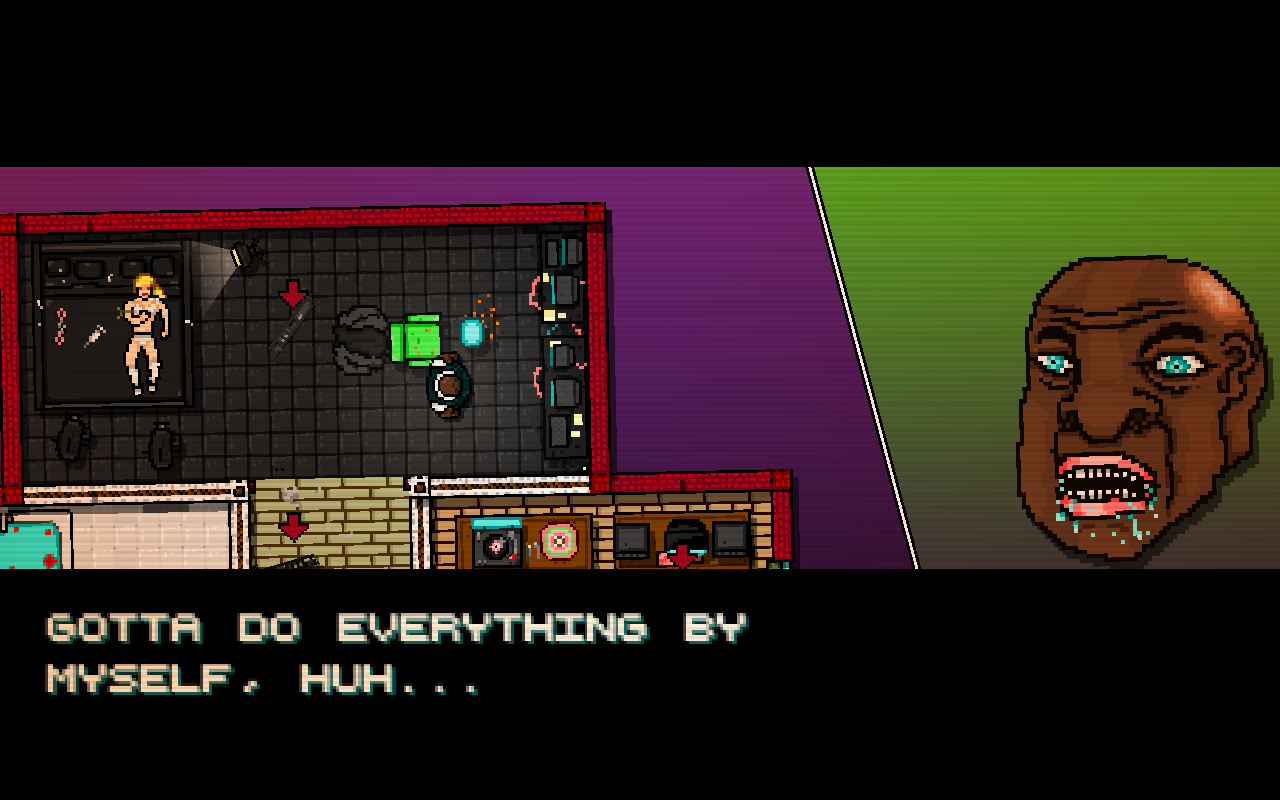

The game's levels do not have any level art outside of the immediate playable area, instead showing just a background that slowly changes colour. This struck me as a missed opportunity because the game's 80's Miami setting is a big part of its appeal, but this setting sometimes struggles to come through in the level art. I think that having visible roads, buildings, vehicles, palm trees and other classic Miami features visible outside the playable area could have helped to tie the whole setting together and make it more believable. However, I do have mixed feelings about this. There's a chance that the level art might clutter the visuals and distract the player from the action in the level itself. Also, additional level art would have meant a greater workload for the developers and a larger file size for the game.

Final Thoughts

Hotline Miami definitely deserves its status as a cult video game and go-to indie title thanks to its fresh aesthetic, simple but challenging gameplay and its strong soundtrack made up of interesting songs. The retro-inspired visuals and pixel art style work well to create a visual experience that stands out. The gameplay premise is to-the-point but actually surprisingly challenging and layered when played. And, of course, the soundtrack somehow suits the game perfectly and ties the whole thing together nicely. I can definitely see why this game turned heads when it came out, even just due to all the things that it does in a way that no other game really has.

Before playing Hotline Miami, I set out to gauge the capabilities of the GameMaker game engine, to see what it could achieve. I am definitely very interested in having a go of the software myself and will look into doing so soon. As for Hotline Miami itself, I think the game has hooked me and I will be playing it again very soon!


Monday, 10 July 2017

Spontaneous Sunday - LIMBO

Welcome to another Spontaneous Sunday! Sticking with last week's theme of indie games, this week I have played the oft-praised indie side-scroller LIMBO (2010, Playdead, OS X). Like last week's game (The Escapists), I picked up Limbo in the recent Steam Summer sale for a fraction of its original price!

"Limbo is a puzzle-platform video game developed by independent studio Playdead. The game was released in July 2010 on Xbox Live Arcade, and has since been ported to several other systems, including the PlayStation 3 and Microsoft Windows. Limbo is a 2D sidescroller, incorporating a physics system that governs environmental objects and the player character. The player guides an unnamed boy through dangerous environments and traps as he searches for his sister."
- Wikipedia on LIMBO


What do I expect from the game?

LIMBO is a game that its almost impossible not to have heard of if you have any interest in gaming or game design. I have heard a lot about the game from various sources, and the name has cropped up a lot during my research into atmosphere in games, so I have been wanting to play it for a while. It is no doubt a hugely successful indie game. I've seen quite a bit of gameplay footage, so I am interested to experience the visuals and atmosphere for myself, and also to see exactly how it feels to play the game.

I expect that the game's strongest features will be its unique visual style, which consists of black-and-white tones and a simplistic approach. LIMBO is often cited as being an example of "games as art", so I will be paying close attention to the visuals and themes to see if I agree with this view. I expect that the atmosphere will be another strong feature. Of course, atmosphere in games is the focus of my MA research, so I will be look at how the different elements of the audio-visual experience are used to create atmosphere.

When it comes to gameplay, I am much less sure of what to expect because I've never played it before! I expect that due to limitations with the silhouette/black-and-white visuals, the gameplay might have to be quite simple - there's only so much one can do with silhouettes in terms of creating interactions, e.g, colours can't be used as a feature of the mechanics. I have heard that it is quite a difficult game and the player should expect to fail often. I've also heard that the game is quite short. I am interested to jump in and see if what I have heard about LIMBO is correct!

First Impressions - What do I think of the game in its first few minutes?

Upon launching the game, LIMBO greets the player with a simple start screen, bearing the game's title. The screen prompts the player to press any key, then the gameplay begins immediately. The player character - an un-named boy - lies on the floor of a forest. Pressing the movement keys opens his eyes, which light up in the darkness, and he stands up. The player receives no instructions of any kind. Of course, as is almost universally the case in side scroller, the player must go right - however, I began by going left instead because there's usually something hidden just to the left of the start point in side scrollers, and LIMBO is no exception - I found some kind of egg-like object, cracked it, and gained a Steam achievement. Then I set off to the right of the screen.

First view of the game world.
The player begins to be faced with challenges and interactions quickly and steadily in the early moments of the game. In the game's first chapter, the player soon learns how to move around, jump and interact by having to traverse a spike-pit, solve a couple of simple puzzles and climb a rope. The simplicity of both the game's visuals and the gameplay itself are immediately apparent at the start of the game. The complete lack of instruction is perhaps a questionable design choice. The controls are very simple indeed (see the control screen below), but I still had to check the control screen to learn that interactions are performed by pressing the Alt key. Alt seems like a strange key choice for interactions. Met with the first obstacle that needed to be interacted with, I tried clicking both mouse buttons, space, enter and several letter keys before giving up guessing and checking the controls. This broke my immersion, and could have been avoided by the simple addition of some on-screen instructions.


The game's atmosphere is clear and strong from the start. The audio and visuals are minimal, but unique and striking. At the beginning of the game, the player is given no information about the world that they are exploring, the character they are controlling, or the reasons behind their actions. This, combined with the silhouette art style, gives an impression of not seeing the full picture, which triggered a natural curiosity within me. However, the game's eerie music, hard-to-see dangers and almost film-noir style also made the game feel instantly unnerving. The interesting mixture of emotions that LIMBO creates drew me into the game quickly and completely.

The first puzzle/interactive object in the game.
The game's earliest puzzles are simple but imaginative and varied. The early puzzles are obviously quite easy, but they are not boring because they are quite creative. Some examples of early puzzles include rowing a boat across a pond, then dragging it out the water so you can stand on it and reach an otherwise-unreachable platform.

The game's dark side soon begins to creep in, with an unidentified object - presumably some kind of body - hanging from a tree and attracting flies that appears early in the game. The dark side also comes through in the player-characters death animations. The un opening few minutes of the game effectively set the scene for what the game is about and how it 

The ominous hanging object is one of the first hints of the game's dark themes.
What do I like about the game?

LIMBO is a game of many well thought-out and well-designed features which combine to create a unique experience that grabbed my attention. The most immediate positive feature is the visuals and atmosphere. This is what the player experiences first, and the game's aesthetic and mood overarches the experience as a whole. The visuals are also probably the game's biggest unique selling point, and it works to the game's advantage that the visuals are so striking, because it will get player's talking and facilitate word-of-mouth exposure for the game. As an indie developer, exposure is crucial to a game's success.


LIMBO is a veritable masterclass in simplicity. The game's visuals are of course a major example of simplicity, but this simplicity is also carried over into other elements, such as the gameplay, narrative and UI. There's something about the lack of story and visual information that makes the game feel uncluttered and not distracting, and therefore easier to take in. Seeing environments, objects and characters only in silhouette gives the player an enhanced sense of space and their surroundings, while the game's physics system means that every object in the environment moves and reacts to input accurately. This adds a sense of realism and control over the surroundings. Though the game takes place in a 2D plane, there are different layers of level art in the foreground and background which add a sense of depth to the game environments. Also, the camera acts dynamically as the player moves through the game world; zooming in and out, panning left and right and blurring the foreground so that each shot is framed effectively, which has a surprising amount of power over the mood of each section.


The subdued visuals allow the quality of the gameplay and audio (two very strong features of the game) to shine through. The audio is similarly minimalistic, but very effective and atmospheric. There is not much music to speak of, only a more ambient, vaguely-musical backdrop. This works to the game's favour as it serves to set a mood of unease without distracting the player or trivialising the experience. Sound effects, meanwhile, make up the majority of the game's soundscape - and they do a good job of it, too. The lack of complicated visual information means that the game has to rely more heavily on sound effect to set the scene, and it achieves this beautifully. Each sound effect is of very high quality and clearly communicates what is happening. The sound effects definitely boost the game's atmosphere massively.

The game's atmosphere is another strong suit, and I can now tell exactly why LIMBO's name comes up so much when researching the subject of game atmosphere. The game's atmosphere finds itself at a rare crossroads of simplicity, unease, bleakness and innocence. The minimal visuals, detailed audio, interesting world and well-balanced gameplay all help the game's atmosphere to soar. The consistency of the game's aesthetic (both in-game and in the UI) helps to tie the atmosphere together. The player will occasionally run into other human characters, who are often hostile. During the first half of the game, the player is pursued by a giant spider. These sections of the game really inject a sense of peril and fear (especially for arachnophobes like myself!)


The gameplay and puzzles are consistently well-designed. The puzzles are only ever of a small scale, and are mostly quite easy to figure out. This means that the player is not left struggling for long periods of time in one area, thus halting progression. The game feels nicely paced because you're never in one section for too long, thus you always feel like you are getting somewhere. There is also a very welcome lack of backtracking and repetition, which are problems that puzzle games often suffer from. The puzzles are also varied, and the game always seems to have new tricks up its sleeve with which to challenge and entertain the player. Puzzles generally involve a handful of set actions, such as moving objects, interacting with levers to change things within the environment, avoiding dangers and so on, but there is definitely sufficient variety to how the designers use the puzzle-building tools at their disposal. The player will find themselves dying a lot in this world, often due to hidden dangers that are often surprising and unavoidable. This both adds challenge and keeps the player guessing about everything in their path.

Danger is everywhere in the world of LIMBO.

The player-character, an unnamed boy, suffers some rather gruesome deaths, from falling in spike pits, to drowning, to being impaled by the giant spider. The gruesome deaths add personality to the game and the setting, giving the environment a bleak and unforgiving vibe, while not being too graphic because the character is simply a silhouette. The game has a wistfully dark mood that radiates from every element. This helps to make the experience of LIMBO stand out and stick in the player's memory.

What do I not like?

LIMBO undoubtedly has many positive points, but I have identified one problem with it. That problem is that the story is almost never divulged to the player. Had I not read a bit about the game's plot before playing it, I wouldn't have had any idea who my character was, where I was, or why I should care about progressing through the game. This could have affected my enjoyment of the game as it played out, and I may have gotten bored without any story motivating me to continue. The game should really have offered some subtle narrative details at the start, and every-so-often thereafter, so that the story unfolded more noticeably as the game continued.


At the time of the game's launch, some critics and players raised concerns over the length of the game in proportion to it's price. Some people thought that it wasn't long enough to warrant its price tag of $15/15 euros. Now, I feel like I am exempt from this concern for two reasons, firstly, I didn't pay full price for the game (I got it for about £2), and I haven't finished it to fully appreciate it's length (I got about halfway through in 2-3 hours). But I can see how this could have been an issue at the game's launch, especially with it being an indie game, which are inherently risky ventures.

The chapter select screen.
The lack of proper introduction to the controls was also a minor issue. Had there been some in-game prompts showing the controls at the very start of the game, the player could pick up the controls instantly and not have to check the controls page like I did. It's only a really small interruption, of course, but it could have helped the start of the game to be more streamlined.

Final Thoughts

Overall, I think that LIMBO is a very strong and unique indie game that has some valuable unique selling points, namely the minimalistic visuals, strong atmosphere and creative puzzles. LIMBO is unlike any other game I have experienced. It lacks so many classic game elements and systems, like scores, different game modes, character interaction and unlockables, but it doesn't seem to suffer at all from the lack of any of this. In fact, LIMBO might even be better off without them. I can definitely see how one might argue that LIMBO is an example of "games as art". Though for me, I found that it was hampered slightly by the lack of narrative. Having a more fleshed-out narrative could have helped the game be even more engrossing and artistic. I suppose this could have undermined the designers vision for the game though.

I am glad to have finally played LIMBO, having heard so much about it before today. As it is such a unique beast, it has been hard to digest it all in one sitting. I'm halfway through now so I will likely finish it off in the next few days and study it some more!


Thursday, 6 July 2017

Sci-fi Garage - APC Modelling - July 5th

It has been a little while since my last Sci-fi garage project update. This is because firstly; a fair portion of my time last month was spent on creating my academic poster/learning agreement, and secondly; the nature of the work that I have been doing on the garage project hasn't really produced anything worth showing!

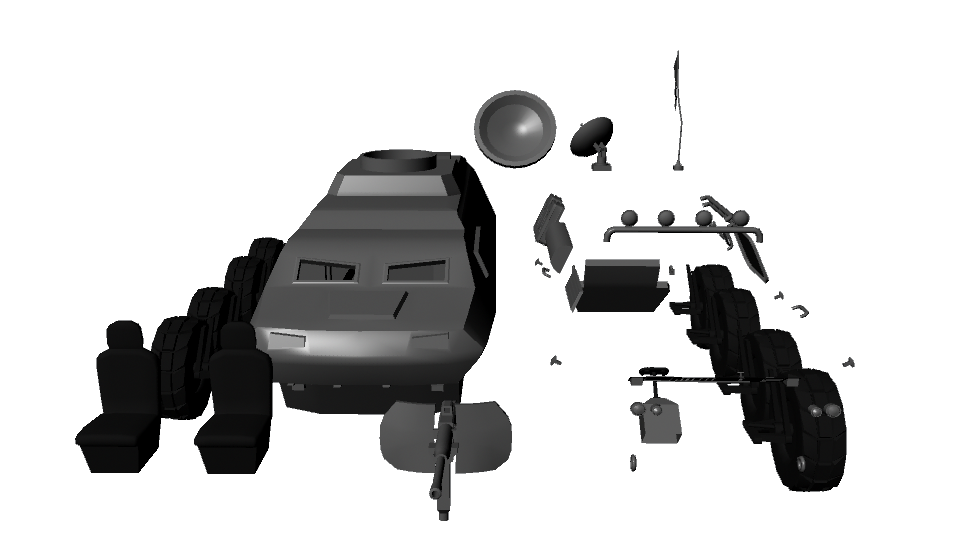
For the past couple of weeks, I have been modelling the armoured personnel carrier that will be acting as the focal point and most important asset in the sci-fi garage environment. This model will likely take up a large portion of the time that I have allocated myself for this project. Now its finally beginning to take shape so I thought I'd post some WIP pictures.

The APC has quickly become one of the most complex models I have created. I've really tried to add a lot of detail and "attitude" to it and give it a strong silhouette for maximum visual impact. There's a lot of different elements to it including the main body, wheels, interior, seats, weapon, lights and various cosmetic adornments such as the jerry cans and shovel on the side. As far as reference/research goes, I've gathered reference from a variety of sources, from image searches to documentaries about current and future armoured vehicles. I also watched Mad Max: Fury Road and borrowed a few ideas from the many vehicles featured in that movie. The APC takes cues from a variety of modern vehicles, most prominetly the LAV-C2, but I have heavily fictionalised it and tried to make it more sci-fi to fit with the theme.


Sunday, 2 July 2017

Spontaneous Sunday - The Escapists

Welcome to another Spontaneous Sunday. It's been a couple of weeks since the last instalment because I've had a couple of very busy weekends, but now I'm back in the game - so to speak! After attending the Manchester Unreal Engine Meetup this week (which had some very interesting talks about independent game development) I have been inspired to look into Indie games and play one for Spontaneous Sunday (you can read about my thoughts on the Unreal Meetup here).

I therefore had a look at the Steam Summer sale and picked up a bunch of new games, including this week's game: The Escapists (2015, Mouldy Toof Studios, OS X). This will be only the second PC game that I have played for Spontaneous Sunday (the other being Breach & Clear).

"The Escapists is a strategy game played from a top-down perspective. The game was developed by Mouldy Toof Studios and following a Steam Early Access release in 2014, was released in 2015 for Microsoft Windows, Xbox 360, Xbox One and PlayStation 4. Players assume the role of an inmate and must escape from prisons of increasing difficulty."
- Wikipedia on The Escapists.


What do I expect from the game?

I am not sure what to expect from The Escapists because, while I was aware of it's existence before playing it, I hadn't heard or seen much about it. I did a bit of research and discovered that it was created by the one-man Indie company, Mouldy Toof Studios, with additional contributions by Team17 who also published the game. Team17's involvement gives me confidence in the game as they are well known as developers and publishers of quality content (The Team17-published couch co-op game Overcooked is a great game).

I think that The Escapists will be a fun, casual strategy game with a charming aesthetic and visuals. I think that the game will not be excessively challenging, and that the gameplay will focus on problem solving and lateral thinking. Originally released on Windows, the game has since also been released on Xbox One, PS4, Xbox 360, Mac, Linux and mobile platforms. This suggests to me that it is a good game, if it has managed to be released to such a wide variety of platforms. The fact that it can run on Android and iOS also suggests to me that the game will not be demanding to run, and may have simple graphics and audio.

As a relatively small-scale and simple indie game, The Escapists is not much like the other games that I have reviewed thus far, which have mostly been big-name console titles. I imagine that The Escapists is closer to the scale of games that I might find myself making in the future if I was ever to pursue an Indie career, so I am hoping to take some inspiration from it and gain a better idea what makes indie games tick.

First Impressions - What do I think of the game in its first few minutes?

The Escapists's charming style is apparent as soon as the front end loads up. The game's 16-bit pixel art style and make for attractive and somewhat nostalgic visuals. Not only that, but the 16-bit visuals no doubt make the game much less demanding to run, which allows it to perform on all the platforms it has released on, as well as low-end computers.


The music is equally retro and charming. The menu music is a quasi-serious synth-y piece with industrial vibes and punchy percussion. It seats itself nicely between the game's serious prison escape themes and it's overall light-hearted, retro presentation. I played the tutorial level, which gently guides the player through how to move around, interact with objects, trade with NPCs and engage in combat. The tutorial level involves finding a screwdriver then using it to break into the prison's air vents. The player then purchases materials to craft a weapon from a fellow in-mate, and uses the weapon knock out a guard and disguise as him in order to escape. It's a short and simple but effective introduction to the game's core mechanics.


The first proper level is in the minimum security prison, "Center Perks". Before beginning the level, the player can choose from a number of varied characters. The characters can either have their default names, or the player can rename them. The prisons also contain a number of other named inmates and guards. Again, the NPC's names can be generated by the game, or the player can name them themselves to add a more personal touch.

The level begins by explaining that a day in the prison consists of a structure timetable of events that include morning roll call, breakfast, gym time and so on. During the day, the player has to take steps towards breaking out of the prison. The player can engage in actions such as working a job, working out in the gym to increase their strength and speed stats (which make them better at fighting), finding items and completing tasks for other inmates to earn money, amongst other activities. Each activity contributes in some way towards creating and executing an escape plan.


The way in which you can complete tasks to work towards achieving goals that can eventually help you to escape is a pretty good gameplay system. It motivates the player to set both short and long term goals for themselves and create a plan of how they will achieve certain things. However, as a new player, I found it hard to actually envisage what sort of methods one could use to escape from the prison, which made it difficult to know what I should really be aiming to work towards.

Screenshot from the tutorial level.
I spent about 3 hours on the first level, trying out different methods and pursuing various paths that I thought might lead me to freedom. This included such things as completing tasks for a fellow in-mate so that he would help me to knock out a guard, I then stole the guards key and made a desperate bid for the exit, but was caught and taken back. I also used a screwdriver to enter the air vents but was caught again.

What do I like about the game?

The Escapists biggest strengths lie in its overall aesthetic and visual style, its unique concept, and the creativity of the actions that you can do in trying to escape the prisons. Other strengths include the music and the game's charm and the small touches that give it its unique character.

I chose to play as "Old Timer" - I liked his style!
The visual style is unique and interesting. Having a 16-bit style works on many different levels: it gives a sense of nostalgic charm, it gives the game a light-hearted vibe, it makes it easy the game easy to run and gives it a small file size which maximises the number of potential platforms and players - this is a good move for an indie developer because accessibility is often pivotal to an indie game's success.

Each NPC has their own stats and equipment.
The overarching concept and how the game plays out is an interesting and unique idea. You have to use a variety of different means to try and escape a prison, but at the same time you are required to learn patterns, increase skills, complete tasks and think creatively in order to stand a chance at achieving the main goal. It quickly became apparent that there was more depth to the gameplay than I had anticipated!

The prison quickly begins to look like a proper working little eco-system, and you come to know the different named inmate and guard NPC's, their schedules, their stats and so on, and you begin to think about how the different characters can be interacted with and used to further your ends. The game's simplistic visuals and simple premise are actually underpinned by a lot of things going on under the surface. NPC's wander around, and items, stats and tasks become available and tick away autonomously.

The player can boost their strength in the gym.
The game is undeniably charming. It's a simplistic, innocent sort of charm, even though the game's prison setting and sometimes-violent themes should convey the opposite! The NPC's have a many lines of dialogue that manifest as lines of text above their heads. They will ramble about all sorts of things and this adds more character both to individual NPCs and the game as a whole.

Finally, the game's music is another positive point. The music is quirky and simple and it suits the 16-bit visuals very well. Though it is simple, it is very high quality and well-composed. It is also repetitive, but not in a jarring way. Judging by reviews and opinions from players that I have read online, the music seems to be one of the most memorable and well-received elements of the game.

You can complete favours for NPCs, including the glitched favour in which
an inmate requested that I beat him up, then paid me for it...!

What do I not like?

While The Escapists surely has its strengths, it is not without its downsides. The most prominent issue that I found with the game is the its pacing and its repetitive nature, that can lead to some frustrating gameplay. While the idea of completing various actions and taking different routes to try and escape is fun and interest, and does call for some creative thinking, the process is too drawn out and slow paced for my liking, and the consequences for failure are often too harsh. If you are caught trying to escape, you are stripped of all your items that you may have worked hard to try and procure, and your attempts at escape are completely reset. Having your progress reset in this way can be disheartening and frustrating - especially if your escape attempt failed because you made a silly mistake.


The Escapists definitely demands patience more patience from the player than I had expected, and success is very much based in trial and error. I am in two minds about the level of difficulty. Moments of victorious feeling and reward are few and far between. Any game that so infrequently rewards the player runs the risk of fatiguing the player and causing them to lose interest. One the one hand, I did begin to lose my patience and willingness to keep trying after multiple failed attempts. However, I was also somehow drawn in by the unexpectedly high level of challenge that the game presented. I think that my expectation of a quick fire casual game were unmet, which caught me off guard. Once I had gotten settled into the idea that this was a game that could not be rushed, I began to appreciate the challenge more.


The game throws the player into the deep end. While there is a tutorial level, it is very minimal and doesn't teach you much besides how to do very basic interactions. The tutorial level is very short and it's simplicity lulled me into a false sense of security in regards to the game's difficulty. On starting the first proper level, I felt very ill-equipped to play the game, and had to spend a good amount of time reading about all the different systems and mechanics (most of which were not mentioned at all in the tutorial) in the game's help menu. A more fleshed out tutorial section would have made the game more easy to adapt to.

Final Thoughts

The Escapists is a very different game from any other that I have played for Spontaneous Sunday, so it has been quite an experience to play it today. I was very impressed by such things as the visual style, music, concept and the game's charm. However, I was also taken aback somewhat by the game's difficulty level, repetitive gameplay and the insufficient tutorial section. I felt a bit defeated after my 3-4 hour Escapists play session due to my initial lack of direction and the game's punishing attitude to failure.

Nevertheless, a big part of my reasoning in playing The Escapists was to gain more experience and knowledge of playing indie games, in the hopes of getting an idea of their scale and scope and what indie developers can achieve. I think that The Escapists was a good starting point for this endeavour, and I plan to play it some more in the future, in a less rushed context when I can focus all my efforts into finally escaping from that first prison! I will also be playing many more indie games in the coming weeks, so keep an eye out for that!